The image edge model
A model for finding higher order sound propagation paths including reflection and diffraction
Overview
The image edge model (IEM) allows finding sound propagation paths in complex environments, such as urban ares, considering reflections and diffractions between a source and a receiver. The method can be considered as an extension of the image source model which also images diffracting edges. Thus, it is capable of considering paths including multiple diffractions.
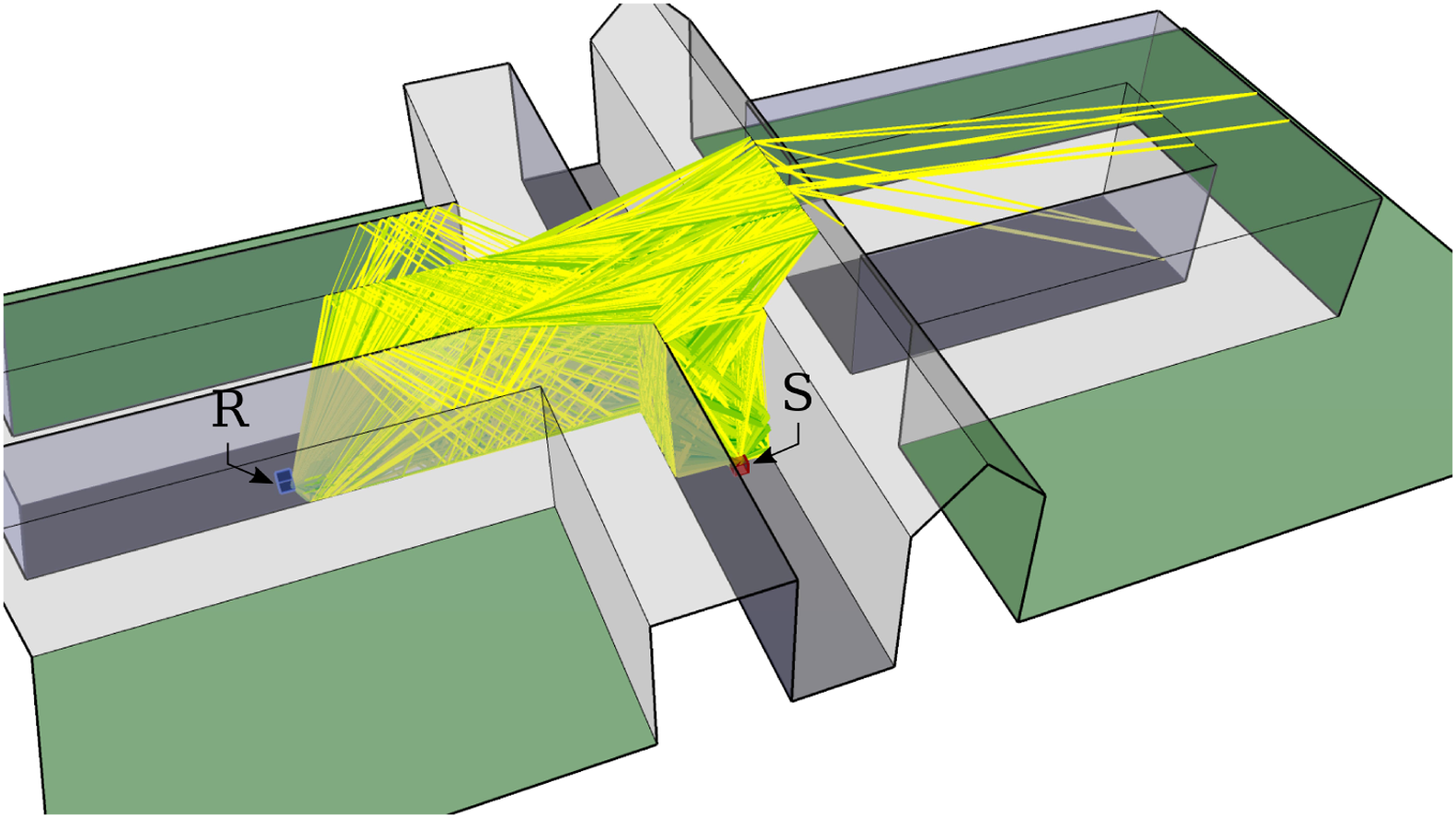
Visualization of propagation paths in an urban area taken from "The image edge model"
The model is designed for the purpose auralization of urban scenarios. To increase the efficiency of the algorithm, it allows to drop irrelevant sound paths at an early stage using back-face culling. Additionally, it provides psychoacoustical culling schemes. These reduce the total number of considered sound paths by estimating their audibility.
Being part of the ITAGeometricalAcoustics C++ library collection, the implementation of the model is open-source and is provided on the respective git repository. The pigeon application allows to run simulations based on the IEM. Those paths can then be visualized or used to derive acoustic filter properties, e.g. propagation delay and air attenuation, for the purpose of auralization.
Scientific publications
A. Erraji, J. Stienen and M. Vorländer
The image edge model
Acta Acustica, Volume 5, 2021
https://doi.org/10.1051/aacus/2021010